The preparation of delicious donuts is an art that integrates tradition with creativity. The round, fluffy treats with a distinctive hole in the center have won the hearts of gourmets around the world. Originating in the United States, donuts have also gained popularity in Poland, becoming a favorite treat for many.
The creation process requires precision and patience. The end result rewards all the hardships. The key to success is the right yeast dough, which achieves lightness and fluffiness after frying or baking.
Glaze or sprinkles give the baked goods a distinct look and taste. For novice pastry chefs, preparing donuts can be a challenge. With the right tips and practice, anyone can create delicious baked goods in their own kitchen.
Whatever your tastes, classic donuts with icing or more elaborate versions with a variety of fillings make for a fascinating culinary adventure.
Basic ingredients and equipment needed to prepare homemade donuts
To prepare classic donuts, you need products that provide the right texture and fluffiness. Wheat flour type 550 or strong bread flour, thanks to its high gluten content, gives elasticity to the dough. Instant or fresh yeast is responsible for fermentation, and the addition of cane or crystal sugar speeds up its activation. Liquid ingredients, such as whole milk heated to 40°C and room temperature eggs, form a uniform emulsion with melted butter.
Example proportions for 12 pieces:
- 500 g flour
- 50 g sugar
- 7 g yeast
- 275 ml of milk
- 2 eggs
Tip: Before adding the yeast to the milk, check the temperature of the liquid. Too hot will kill the bacterial cultures, and too cold will slow down the fermentation.
Essential kitchen tools
Preparing donuts requires accessories to facilitate shaping and heat processing. A metal doughnut punch with a central cylinder 8 cm in diameter allows you to obtain even shapes. For deep frying, a wide pot with a thick bottom or a deep fryer that maintains a constant oil temperature (180°C) works best. A kitchen thermometer with a range of up to 200°C helps monitor the heating of the fat and prevents burning.
Alternatives to professional tools:
- Sharp-edged glass small hole punching glass
- Cast iron skillet with high edges instead of a deep fryer
Flavor additions and substitutions
Original recipes can be modified to make a variety of variations. Replacing cow’s milk with a plant-based beverage, such as almond or oat milk, gives the dough a mildly nutty flavor. For a gluten-free version, a 3:1 mixture of rice flour and tapioca flour will work well. For sprinkles, you can use not only powdered sugar, but also powdered matcha, sponge cake crumbles or dried raspberry flakes.
Tip: For a more intense flavor, add a teaspoon of vanilla extract or grated orange peel to the wet ingredients before combining with the dry ingredients.
Step-by-step process for preparing the dough, kneading and rising the dough for donuts
Yeast activation is the foundation of a successful dough. In a glass of water or milk heated to 40°C, dissolve a teaspoon of cane sugar, then add 7 g of instant yeast. After 10 minutes, a foam about 2 cm thick should appear on the surface. No reaction means that the yeast must be replaced.
When using fresh baker’s yeast, the ratio is 20 g per 500 g of flour.
Optimal liquid parameters:
- Temperature 38-42°C for instant yeast
- 32-35°C for fresh yeast
- pH 4.5-6.0 (check with litmus strips)
Tip: Adding a pinch of rye flour to the activation liquid accelerates the development of yeast cultures.
Mixing and kneading the dough
Combining dry ingredients (flour, salt, spices) with wet ingredients (eggs, yeast liquid, butter) requires a specific order. In the bowl of a food processor with a dough hook, place the liquid base, then gradually add the sifted flour. Mix the whole thing for 5 minutes on medium speed, until the mass reaches a uniform consistency.
Stages of dough consistency:
- Phase of “shaggy dough” – irregular, dry pieces
- Full hydration point – smooth, elastic surface
- Window stage – the stretched part of the dough does not tear, forming a thin membrane
Mechanical kneading takes an average of 12-15 minutes. When mixing by hand, the time is increased to 25 minutes, using the folding and hammering technique.
Fermentation and control of the rising process
The first rising is carried out at 26-28°C for 90-120 minutes, until the volume increases 2.5 times. The dish is covered with a damp cloth or cling film with several holes.
After this time, the dough should show:
- Visible air bubbles under the surface
- A springy texture when gently pressed with a finger
- Characteristic smell of esters and alcohols
The second rising occurs after the shapes are formed. It lasts 45-60 minutes at 30-32°C. During this stage, the volume increases by 70-80%.
Tip: To slow down the fermentation and enhance the aroma, the first rising can be carried out in the refrigerator for 8-12 hours. Monitoring the progress of fermentation can be done with a finger test – a well-risen dough slowly returns to its original shape when lightly pressed. Excessive rising is manifested by a permanent depression and a sour milk smell.
Critical process parameters:
| Phase | Temperature | Humidity | Time |
|---|---|---|---|
| I rising | 26-28°C | 75-80% | 1.5-2h |
| II rising | 30-32°C | 85-90% | 45-60min |
Monitor the progress of fermentation with a finger test: properly risen dough slowly returns to its original shape when lightly pressed. Over-rising is manifested by a permanent depression and a sour milk smell.
Forming perfectly round donuts without special molds
Transforming a standard muffin tin into a donut tool requires a creative approach. Cylinders with a diameter of 2-3 cm and a height corresponding to the depth of the indentations in the tin are formed from thin aluminum foil. Each roll is placed centrally in an oiled area, creating space for a distinctive hole.
Step sequence:
- Form 12 identical foil rolls
- Spray the indentations and foil with anti-stick preparation
- Fill the confectionery sleeve with dough of thick cream consistency
- Apply the mixture in a circular motion around the foil core
Tip: For precise filling, use a sleeve with a metal round tip #12. It will ensure even distribution of the dough.
Alternative tools for punching out shapes
For traditional fried donuts, everyday items work well. A glass with a diameter of 8 cm, together with a bottle cap (3 cm), form a set for cutting out discs. It is important that the edges of the tools are sharp. Dull edges can cause creases in the dough.
For yeast dough with a moisture content of 65%, use simultaneous pressing of both tools with a force of 3-5 kg. In the absence of suitable objects, an index finger wrapped in cling film allows you to make a hole by hand.
Parameters of substitute tools:
| Element | Recommended diameter | Material |
|---|---|---|
| Outer punch | 7-9 cm | Metal/stainless steel |
| Internal punch | 2.5-3.5 cm | Food grade plastic |
Tip: Chill the tools in the freezer for 15 minutes before cutting out. The cold surface will reduce dough sticking.
Hand forming methods for precise shapes
For uniform discs without tools, a “double rolling” technique is used. First roll out the dough to 1.5 cm thick, then rest 10 minutes in the cold (8-10°C). Subsequent rolling to 1 cm eliminates the unevenness created during the relaxation of the gluten.
Quality control of shapes:
- Measurement of the diameter – with a kitchen circulator
- Float test – a correctly formed donut stays on the surface of the oil for 2 seconds before being dipped
- Density analysis – 35-40 disks from 1 kg of dough
For donut hole shapes, 15-gram balls are formed by rolling between hands with light pressure (50-70 g/cm²).
Tip: Use a kitchen scale with an accuracy of 1 g to divide the dough evenly. Differences greater than 5% will result in uneven frying.
Techniques for frying donuts to a golden color and fluffy texture
The right temperature of the fat determines the final texture and appearance. For frying classic yeast donuts, it is recommended to maintain a range of 170-175°C throughout the process. Higher values (above 185°C) lead to rapid browning of the surface with an undercooked center.
To measure, use a confectionery thermometer with an accuracy of ±2°C, placed 5 cm above the bottom of the dish.
Alternative calibration methods:
- Test of a piece of bread – a 3×3 cm cube should reach a golden color in 50-55 seconds
- Observation of bubbles – at 170°C, a moderate number of bubbles with a diameter of 2-3 mm are formed around the immersed dough
Tip: For even heating, use copper or aluminum dishes with a minimum wall thickness of 4 mm. They stabilize the heat exchange.
Dipping and turning techniques
Precise handling of the dough in the hot fat minimizes oil absorption. Using a stainless steel straining spoon with 2 mm perforations allows you to control the depth of dipping.
The first side is fried for 65-75 seconds, until the edges achieve a light brown ring 3-4 mm wide. Turning is done with a gentle rotating motion, avoiding piercing the surface.
Optimum frying conditions:
| Parameter | Value |
|---|---|
| Time per side | 70 ±5 s |
| Oil depth | 8-10 cm |
| Quantity at a time | 3-4 pieces |
Common mistake:
Dipping the dough by dropping from a height of more than 15 cm leads to uneven heat penetration. Correct dipping is realized by lowering the donut on the strainer until it is completely covered with fat.
Tip: Before frying, spray the surface of the dough with water from an atomizer. A thin layer of steam reduces excessive oil absorption.
Handling after frying
Proper drainage of excess fat ensures a light texture. A two-step process is used:
- Initial drainage on a steel sieve (30-45 s)
- Transfer to a double layer of bamboo fiber paper towels
When glazing, the donuts are cooled to 32-35°C on a vented grid. This prevents the topping from delaminating.
Critical final errors:
- Storing in a closed container before cooling – causes moisture buildup
- Applying icing to hot surfaces – leads to uneven distribution
- Reheating in the microwave – destroys pore structure
Tip: To prolong crispness, place donuts in a single layer in parchment paper and freeze after cooling. Reheat in a convection oven for 3 minutes at 180°C.
A solution for the catering business: preparing donuts using a professional waffle maker
Professional waffle irons for making donuts allow producing 180-220 pieces per hour with full automation. Models with double HPDC (High Pressure Die Casting) aluminum alloy heating plates reduce heating time to 90 seconds.
A built-in PID system controls the temperature between 150-230°C with ±1.5°C accuracy, eliminating the risk of burning.
Key parameters of the units:
- Power 2200-2500 W for single-plate units
- Scratch-resistant Diamond Shieldceramic coating
- Automatic shut-off after 60 minutes of inactivity
Tip: For premises with limited space, the compact 40×30 cm models with vertical storage function are best. The mini version will work well for cafes serving coffee snacks – 250-300 servings per day with 8-hour operation. Heart models are ideal for themed events, wedding catering and events.
Analysis of models dedicated to different sales formats

An overview of the equipment available at Gofrex.com indicates product specialization:
| Model | Promotional price | Performance | Specifics |
|---|---|---|---|
| Waffle maker for Donats | 995 PLN | 25 pcs/batch | Plates with indentations Ø8 cm |
| Waffle Maker for Donuts Hearts | 995 PLN | 18 pcs/batch | Valentine shape |
| Waffle Maker for Mini Donuts | 999 PLN | 40 pcs/batch | Ø3.5 cm, cycle time 2.5 min |

Return on investment calculation
- Average cost of production of 1 donut – 0.85 PLN
- Retail price – 4.50-6.00 PLN
- Profitability threshold at 50 pieces per day – 23 days
Integration with the production line and optimization
Professional equipment can be integrated with hopper dough feeding systems and conveyor belts. For foodservice operators with an annual production of more than 100,000 pieces, it is recommended:
- Installation of refrigerated transport shelves
- Integration with a glazing robot
- Vacuum packaging machine system
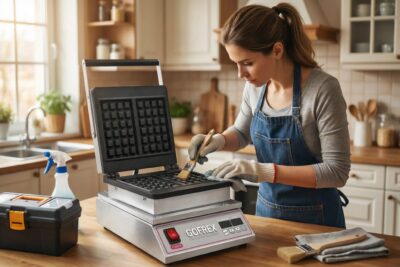
Cleaning procedure
- Cool the plate to 45°C
- Remove residue with a silicone spatula
- Wash with a damp cloth with ceramic detergent
- Protect the surface with cooking oil
To maintain the warranty, it is necessary to service every 15,000 production cycles or every 6 months. The cost of servicing is 8-12% of the value of the device.
A variety of glazes and fillings for donuts for beginner confectioners
The classic glaze is the foundation of donut decoration. A mixture of powdered sugar (400 g), whole milk (60 ml) and vanilla extract (5 ml) creates a smooth, glossy coating. For a uniform consistency, the ingredients are mixed with a whisk at 20-25°C, avoiding excessive aeration.
A dairy-free version is prepared by replacing milk with lemon juice (45 ml) and rose water (15 ml).
Color and flavor variations:
- Green glaze – 15 g of powdered matcha for a tea-like flavor
- Creamy glaze – 30 g of melted white chocolate
- Intense shades – 2 drops of gel food coloring
Tip: To avoid crystallization, store the finished glaze in an airtight container with a damp cloth over the surface.
Cream and fruit fillings
A traditional Boston-type filling is made by combining butter (100 g), powdered sugar (200 g) and vanilla extract (5 ml) with whipped cream (120 ml). The mixture remains stable for 4 hours at room temperature.
A vegan version can be prepared with canned coconut milk (400 ml) cooled for 24 hours and blended to a creamy texture.
Filling sequence:
- Use a confectionery sleeve with a metal tip Bismarck #230
- Make a puncture at a 45° angle in the side of the donut
- Introduce 15-20 g of filling under constant pressure
For fruit fillings, pureed frozen raspberries (150 g) mixed with gelatin (10 g) and sugar syrup (50 ml) works well. The mixture has a semi-liquid consistency and a sour-sweet aftertaste.
Tip: To prevent the filling from seeping through, cover the inside walls of the donut with a thin layer of dessert chocolate.
Experimental decorations using food ingredients
Modern trends include the use of custom texturizing additives. A sprinkling of crushed roasted yeast flakes (60 g) with sea salt (5 g) provides a salty-sweet contrast.
Liquid nitrogen (-196°C) helps create striking mists on the surface of the icing. For breakfast versions, a yogurt frosting (150 g Greek yogurt 300 g powdered sugar) with honey-roasted oatmeal works well.
Tip: Use vegetable concentrates, such as beet or spinach, for quick coloring frostings. Just 1/4 teaspoon is enough to give intense color without affecting the taste.
The most common mistakes when making donuts and how to avoid them
Precise measurement of ingredients is key to making perfect donuts. Even small deviations can affect the final result. A common mistake is using “mounded” instead of “flat” measuring cups or estimating the amount of liquids by eye.
To avoid problems, it is best to use a set of kitchen measuring cups and a scale. Experts recommend using a scale for even more accurate results, since the density of ingredients can vary.
Product quality also plays an important role. Old or expired ingredients, especially yeast, can cause failure. Fresh yeast is essential for the dough to rise properly. It is a good idea to check the expiration date of all ingredients before using them.
Tip: To test the freshness of the baking powder, add some water to it. If it begins to foam within a few seconds, it is suitable for use in the recipe.
Problems with kneading and rising dough
Excessive kneading activates the gluten, which makes the donuts rubbery. Insufficient mixing, on the other hand, can result in an uneven texture. Timing is key – the dough should be kneaded until a consistent, elastic mass is formed.
The rising process is equally important. Skipping or shortening this step is a common mistake, especially among novice confectioners. Rising affects not only volume, but also flavor development.
A study published in the journal Food Research International indicates that dough should rise for at least an hour. Longer time, up to 2 hours, can enrich flavor and improve crumb structure.
Signs of proper rising:
- The dough doubles in volume
- When gently pressed with a finger, the indentation slowly returns to its original shape
- The structure becomes light and full of air bubbles
Mistakes during frying
The temperature of the oil is crucial to get the right texture. Fat that is too hot causes the outer layer to burn with an undercooked center. Too low a temperature causes the donuts to absorb excess oil and become heavy.
How to avoid problems:
- Use a kitchen thermometer for precise control
- Keep the oil temperature between 175°C and 190°C
- Don’t overfill the pan – frying too many donuts at once lowers the temperature of the fat
- Allow the oil to return to its optimal temperature after each batch
Tip: If you don’t have a thermometer, check the temperature of the oil by dropping a small cube of bread into it. If it browns within 50-55 seconds, the fat is ready for frying.
Storing and refreshing homemade donuts to keep them fresh
A key factor in maintaining freshness is humidity and temperature control. Donuts stored at room temperature (20-22°C) remain soft for up to 24 hours if placed in an airtight container with a layer of parchment paper between the disks.
For higher ambient temperatures ( 25°C), moisture absorbers are recommended. Silicone granule pouches placed under the lid reduce moisture.
Safety materials:
- Vacuum containers with hand pump
- Ceramic dishes for natural air circulation
- Waxed paper instead of cling film
To avoid condensation, never place warm donuts in a closed container. Wait until they have cooled completely (45-60 minutes).
Methods for regenerating stale baked goods
Donuts losing their crispness can be restored to near-fresh condition using thermal techniques.
In a convection oven preheated to 160°C, place the disks on a griddle over a pan of water (100 ml). Bake for 3-4 minutes – the steam will moisten the texture, and the heat will restore crispness.
Alternatively, fry in a pan with a tablespoon of clarified butter for 60 seconds on each side.
Tip: It’s best to use a hair dryer on cold air mode to refresh donuts with icing. The air stream will fix the icing without melting it.
Advanced freezing techniques
Long-term storage requires precise preparation. Wrap each donut individually in food paper, then place in string bags with the air removed (sous-vide method).
The optimal freezer temperature is -18°C or lower. This ensures a shelf life of 4-6 months.
Thawing process:
- Transfer the frozen discs to a shelf in the refrigerator for 8 hours
- Leave at room temperature for 30 minutes
- Heat in the oven for 2 minutes at 150°C
To preserve the integrity of the chocolate toppings, it is a good idea to spray them with a gelatin solution (1 teaspoon per 50 ml of water) before freezing.
Technical data:
- Moisture loss during freezing: 2-4%
- Permissible temperature fluctuation: ±3°C
- Recommended freezer capacity: 1/3 free space for air circulation
Summary
Preparing delicious donuts requires precision, patience and creativity. Key elements include the selection of ingredients, proper kneading and rising of the dough, shaping techniques and proper frying. Professional equipment, such as donut waffle makers, can streamline production in a commercial setting.
The variety of toppings and fillings allows you to experiment with flavors, creating unique compositions. To avoid disappointment, it is important to pay attention to the most common mistakes, such as incorrect ingredient proportions or the wrong frying temperature.
Proper storage and refreshing techniques are as important as the preparation process itself. They allow you to maintain freshness and high quality for a longer period of time. Following the tips presented here makes it easier for novice confectioners to achieve satisfactory results and develop their own style.
Mastering the art of preparing donuts provides culinary satisfaction and can be the beginning of a fascinating adventure in confectionery – both in the home kitchen and in a professional environment.